

For most corporate and retail applications, a left chest logo is digitized to fit within a 3.5" to 4" width. For circular or square logos, 2.5" to 3" is often the preferred scale. We always recommend measuring the specific garment size to ensure the logo is proportional and doesn't wrap too far toward the underarm.
Left Chest Digitizing
- Home
- Digitizing
- Left Chest Digitizing
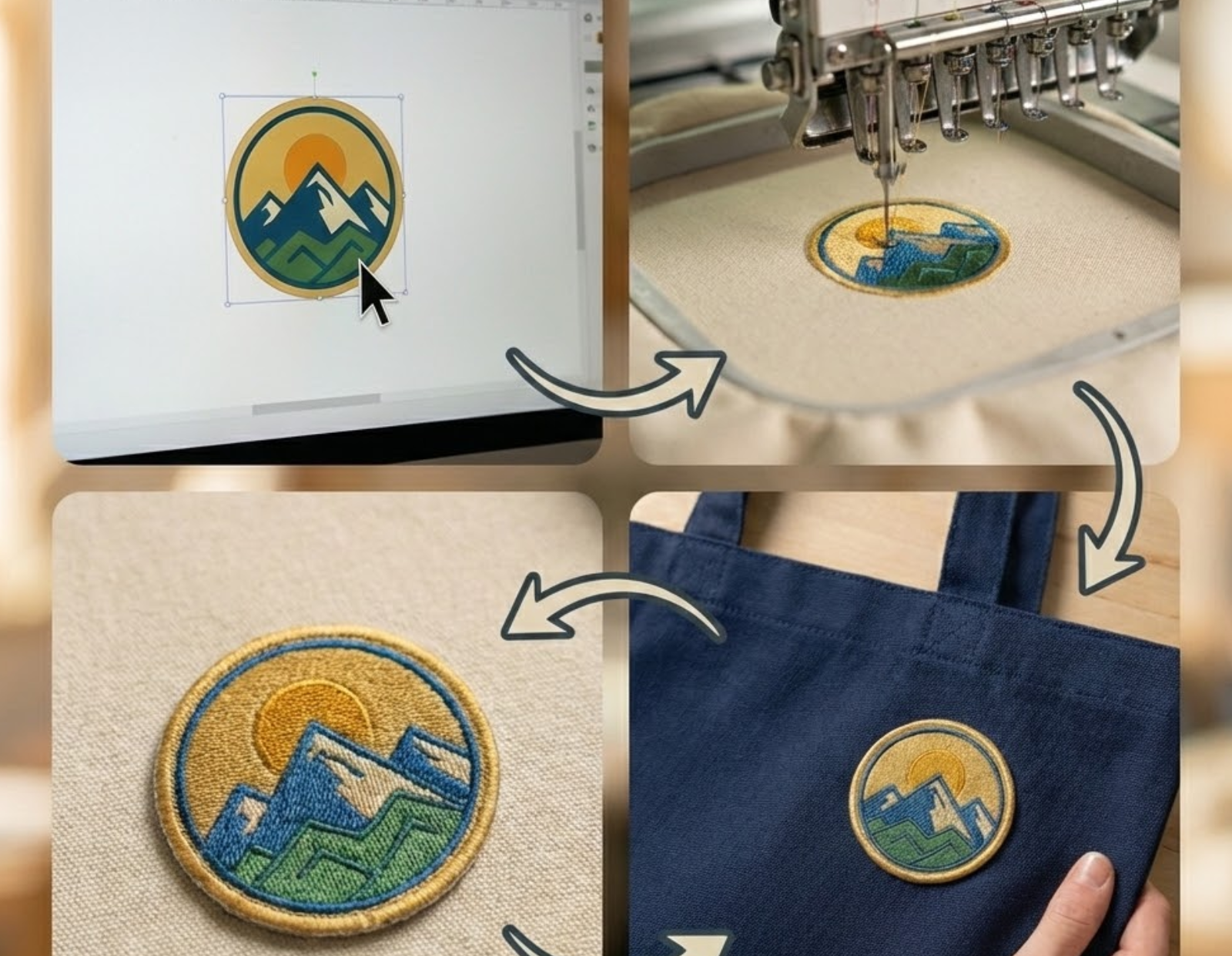
Precision Branding for Professional Corporate Identity
At High Rated Patch, we specialize in left chest digitizing—the industry standard for corporate uniforms, executive polos, and retail apparel. This specific discipline of embroidery requires a higher level of technical precision because it involves translating complex brand identities into a confined 3-inch to 4-inch workspace. We focus on micro-legibility and structural stability, ensuring that your logo remains crisp, flat, and professional across various garment types.
Our left chest digitizing process includes a Substrate Sensitivity Analysis. We don't use a "one-size-fits-all" file; instead, we engineer the stitch logic specifically for the fabric it will be applied to—whether it’s the textured weave of a pique polo, the stretch of a performance tee, or the heavy density of a softshell jacket.

Micro-Text & Detail Clarity
The greatest challenge in left chest embroidery is rendering small taglines, URLs, and intricate logo elements. At High Rated Patch, we utilize Advanced Pathing Algorithms and specialized "thin-thread" logic to ensure that text as small as 4mm remains perfectly legible. We manually adjust the start and stop points of every letter to prevent "thread-clustering," resulting in a clean, retail-quality finish that enhances your brand’s perceived value.

Puckering Prevention & Stabilization
Left chest areas are prone to "puckering"—the unsightly wrinkling of fabric around the embroidery. Our engineers prevent this by utilizing Push-Pull Compensation and strategic Underlay Foundations. By laying down a stabilizing "skeletal" stitch before the top layers, we lock the garment's fibers in place. This ensures that even after multiple industrial wash cycles, your logo remains perfectly flat and aligned without distorting the garment's shape.
Technical Specifications & Features
Our digitizing service provides production-ready files optimized for all major industrial embroidery machine brands.
- File Formats
- Design Features
DST (Tajima)
The universal industry standard for industrial embroidery machines. It contains all stitch and jump data without proprietary color locks.
PES (Brother/Baby Lock)
The primary format for many multi-needle and home-professional machines.
EXP (Melco/Bernina)
A high-precision format used by Melco industrial systems, similar to DST but with specific scaling logic.
EMB (Wilcom Master File)
The "Source Code" of your design. It preserves all object properties, allowing for easy resizing and density adjustments.
VP3/HUS (Husqvarna/Viking)
Optimized for specific European machinery and high-end embroidery setups.
JEF (Janome)
A specialized format for Janome industrial and professional-grade systems.
PDF Production Worksheet
We provide a technical "spec sheet" including stitch counts, color sequences, and size dimensions for your production team.
Custom Density Calibration
We adjust the number of stitches per millimeter based on the thread weight and fabric type to prevent "birdnesting" or fabric show-through.
Underlay Strategy
We engineer "foundation stitches" (center run, zigzag, or tatami) to stabilize the fabric and provide a 3D lift to the top stitching.
Automated Trim Reduction
We manually sequence the design to eliminate unnecessary thread trims, resulting in a cleaner finish and faster machine run-times.
Small Text Optimization
We utilize specialized "micro-stitch" settings for lettering as small as 4mm to ensure legibility and needle safety.
Satin vs. Tatami Mapping
We strategically assign Satin stitches for borders and high-gloss areas, and Tatami (Fill) stitches for large surface areas to balance texture and weight.
Appliqué Pathing
For large patches, we provide specialized "tack-down" and "cover-stitch" paths to integrate fabric inserts with embroidery.
Showcase
Recent Left Chest Digitizing Projects
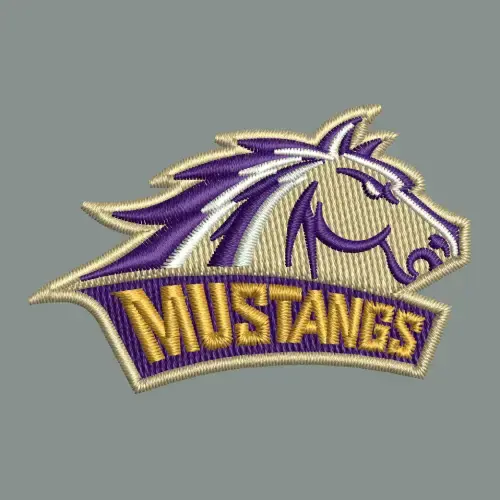
Browse our digitizing gallery to see the "Stitch Map" vs. the "Final Result," demonstrating the precision and texture we bring to every design.
FAQs
Have Any questions?
Find answers to the most common questions about the digitizing process and how it affects the quality of your custom patches.
What is the standard size for a left chest logo?
Why can’t I use the same file for a polo and a jacket?
A polo is a stretchy knit, while a jacket is often a stable woven or a thick fleece. A file digitized for a jacket has too many stitches for a polo, which would cause the polo to "pucker" and wrinkle. Conversely, a file for a polo might look "thin" on a jacket. We provide Fabric-Optimized files to ensure the stitch density matches the weight of the garment.
What is the smallest font size you can digitize for a left
chest?
To maintain professional legibility, we recommend a minimum height of 5mm (approx. 0.2 inches) for standard block fonts. For complex serif or script fonts, 6mm to 7mm is safer. If your logo has extremely small text, we can utilize specialized "micro-digitizing" techniques to maximize clarity.
How do you prevent the "bullet-hole" effect on thin
t-shirts?
The "bullet-hole" effect happens when the stitch density is too high for a thin fabric, causing the needle to cut the fibers. We prevent this by using Lightened Fills and Strategic Underlays. Instead of using raw thread density to create color, we use a stable foundation that supports a lighter top-layer, keeping the patch soft and flexible.
What is "Center-Out" digitizing and why is it important?
When a machine stitches from left to right, it pushes the fabric in one direction, often leading to misalignment. Center-Out digitizing starts in the middle and moves outward in both directions. This balances the fabric tension and is the only way to ensure 100% accurate registration on performance fabrics and structured caps.
Can I put a 3D Puff logo on the left chest of a shirt?
While possible, 3D Foam (Puff) is generally recommended for hats and heavy outerwear. On a polo or t-shirt, the foam can be too heavy and may cause the fabric to sag. If you want a "raised" look on a shirt, we recommend using a High-Density Satin Stitch or a Chenille Hybrid, which provides dimension without the bulk of foam.
How do you handle logos with many different colors in a
small area?
In a small left chest space, too many color changes can lead to "bulk" and excessive trims. We optimize the color sequence to group colors together, and we utilize "layer-blending" techniques to reduce the number of physical thread layers, keeping the logo thin and comfortable against the skin.
Do you digitize for pocket embroidery?
Yes. Pocket embroidery requires a specific size limit (usually 3" width) to ensure the machine frame can fit inside or above the pocket. We also offer "Above Pocket" digitizing, where the logo is arched or centered to complement the pocket's geometry without sewing the pocket shut.
Why does my logo look "skewed" after it is stitched?
This is usually due to poor "Push-Pull Compensation." As the machine stitches, the thread pulls the fabric together. If the digitizer doesn't account for this, your squares will look like rectangles and your circles like ovals. Our engineers apply mathematical compensation to the digital file so it "settles" into the perfect shape once stitched.
Can I get a DST file that is ready for production
immediately?
Absolutely. All of our left chest files are Production-Ready. They include all necessary trims, color stops, and underlays. You can load our DST file directly into any Tajima, Barudan, or Brother machine and start stitching immediately with full confidence in the quality.
Call Us Now