A Raster logo is composed of a fixed grid of pixels. When you enlarge it, the software must "guess" the missing data, resulting in blurriness and jagged edges (pixelation). A Vector logo is composed of mathematical coordinates. Because it is math-based, you can scale it to the size of a billboard or shrink it to a postage stamp, and it will remain 100% sharp. For physical manufacturing, vectors are mandatory because machines need "paths" to follow, not a grid of colored squares.
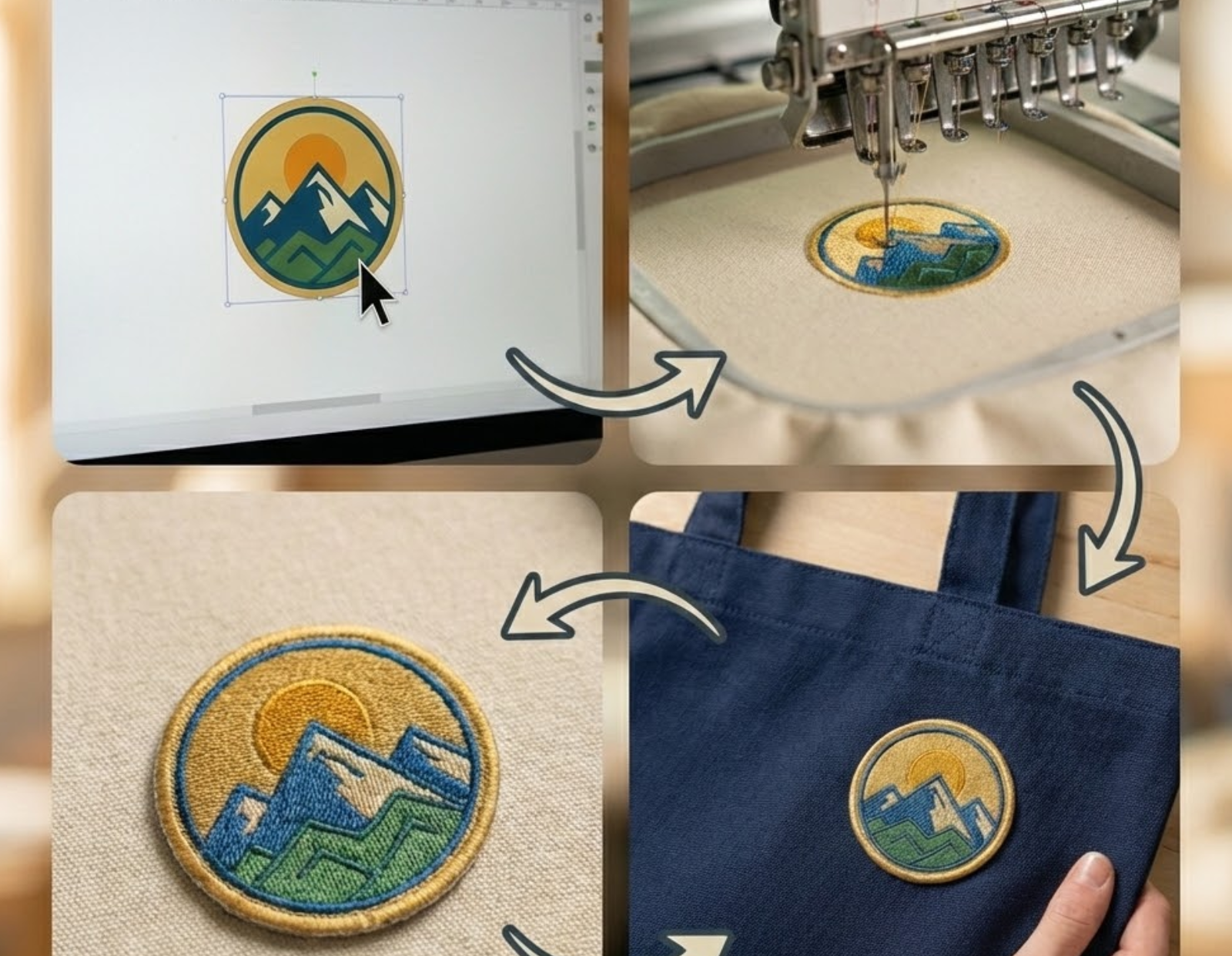
Production-Ready Technical Vector Illustration
At High Rated Patch, we understand that a premium patch begins with a flawless digital blueprint. Our vector logo design service focuses on the creation of mathematically-defined graphics that provide infinite scalability without any degradation in resolution. Unlike raster images (JPEG/PNG) which rely on pixels, our vector designs are engineered using paths, nodes, and anchors. This makes them the absolute industry standard for embroidery digitizing, CNC mold making, laser engraving, and high-fidelity textile printing.
Our design philosophy is rooted in Design for Manufacturing (DFM). We don’t just create "artwork"; we develop technical assets optimized for industrial machines. Every curve is smoothed, every node is audited, and every line weight is standardized to ensure your logo translates perfectly into thread, PVC, leather, or ink.

Mathematical Scalability & Precision
The core advantage of our vector services is the transition from resolution-dependent pixels to coordinate-based geometry. Whether you are scaling your logo for a small 0.5-inch lapel pin or a 20-inch oversized jacket back, the artwork remains razor-sharp with zero "pixelation." We utilize industry-leading software to ensure your brand’s curves are defined by Bézier paths, providing a level of precision that allows for flawless translation into physical mediums.

Production-Grade Vector Structuring
Our vectors are engineered with clean paths, controlled node placement, and standardized line weights to ensure flawless interpretation by embroidery machines, laser cutters, and printing systems. This disciplined structure eliminates distortion, reduces production errors, and guarantees consistent results across all manufacturing methods and material types.
Technical Specifications & Features
Refine your brand assets with professional-grade file formats and design structures optimized for every industrial application.
- File Formats
- Design Features
AI (Adobe Illustrator)
The master source file. It preserves all live layers, paths, and metadata, serving as the primary blueprint for your brand’s future.
EPS (Encapsulated PostScript)
The universal production standard. Compatible with high-end industrial printers, vinyl cutters, and embroidery software.
SVG (Scalable Vector Graphics)
Optimized for the web. These files are lightweight and remain sharp at any zoom level on digital displays.
PDF (Vector-Embedded)
A universal, high-resolution viewing format that maintains all vector path data for easy sharing and proofing.
CDR (CorelDRAW)
Essential for many traditional manufacturing and embroidery setups globally, ensuring maximum software compatibility.
DXF/DWG
Specialized formats for CNC routing, laser cutting, and metal mold production—crucial for PVC and metal emblems.
PNG/TIFF (High-Res)
We also provide transparent, high-DPI raster exports for immediate use in presentations and social media.
Global Pantone® Swatch Assignment
We assign specific Pantone Solid Coated codes to your paths to ensure 100% color consistency between your screen and the physical product.
Layered Path Architecture
Artwork is logically organized into color-coded layers, facilitating easy separation for screen printing or PVC mold injection.
Typography Outlining
All fonts are converted into solid vector shapes, ensuring your branding remains intact even if the manufacturer does not have your specific font installed.
Line Weight Standardization
We ensure every line meets the 0.1mm minimum threshold required for physical production visibility.
Anchor Point Optimization
We manually reduce redundant nodes, creating "clean topology" that allows manufacturing machines to run faster and smoother.
Negative Space Auditing
We optimize the gaps between elements to ensure they are wide enough to be rendered clearly in stitches or molded plastic.
Showcase
Recent Vector Design Projects
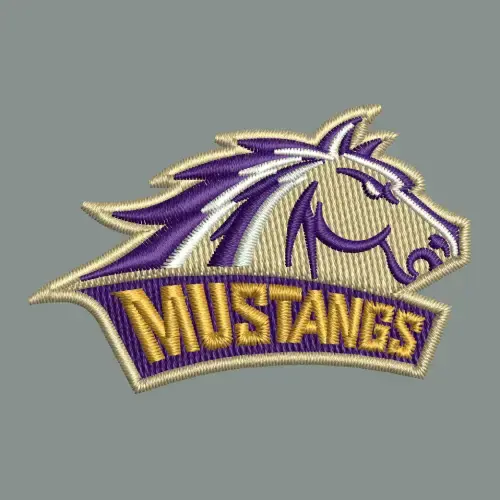
Browse our latest technical illustration work to see how we transform low-resolution images into professional, production-ready brand assets.
FAQs
Have Any questions?
Find answers to the most common questions about our vector design process and why it is critical for your brand.
What is the fundamental difference between a Vector and a
Raster (JPEG/PNG) logo?
Why is a vector file strictly required for high-quality
patch manufacturing?
Manufacturing equipment—whether it’s an embroidery machine, a laser engraver, or a CNC mold cutter—operates on "vector paths." These machines need to know exactly where to start, move, and stop. A raster image (JPEG) doesn't provide this data; it only tells the computer what color a pixel is. Without a vector file, the manufacturing software cannot accurately "read" your logo, leading to distorted shapes and poor quality.
Can you vectorize a blurry photo taken on a smartphone?
Yes. This technical process is called Manual Vector Tracing. We take your low-resolution photo or sketch and place it on a digital "light table." Our designers then hand-draw every line and curve using precision pen tools. We do not use "auto-trace" filters, which often produce messy, unusable nodes. Instead, we rebuild your logo from scratch to ensure the geometry is clean and production-ready.
What does "Outlining Fonts" mean and why is it important
for my logo?
When a designer uses a font, the computer treats it as "live text." If you send that file to a manufacturer who doesn't have that specific font, their computer will replace it with a generic one, ruining your brand. By "Outlining," we convert the letters into solid vector shapes (paths). The computer no longer sees it as a font, but as a drawing. This guarantees your typography will look exactly the same on any computer in the world.
How do Pantone® colors in a vector file ensure my patches
look right?
Computer screens use RGB (light) and printers use CMYK (ink), which can look very different. Pantone is a universal color matching system used in manufacturing. By assigning a Pantone code to your vector file, we give the production team a "physical recipe." Whether they are mixing liquid PVC or selecting embroidery thread, they use that code to ensure the color of the final patch matches your brand's digital identity perfectly.
Can a logo be "too detailed" for a vector-to-patch
conversion?
Digital screens can display details that are physically impossible to recreate with a needle or a mold. During the vectorization process, we perform a Technical Audit. If a line is too thin to be stitched or a gap is too small for a mold, we will slightly adjust the vector geometry to ensure the design is "manufacturable." This foresight prevents your final product from looking "muddy" or cluttered.
How does a clean vector file reduce my manufacturing
costs?
Machines charge by "run time." If a vector file is messy—with thousands of unnecessary anchor points or overlapping paths—the machine has to stop and start constantly, which takes longer and costs more. We provide "Clean Topology" files with the minimum number of nodes required, allowing the machine to move in a fluid, continuous path. This reduces production time and often results in a lower per-unit cost for you.
What is the difference between AI, EPS, and SVG file
formats?
AI is the "working file" used by designers to make edits. EPS is the "output file" sent to industrial printers and manufacturers; it is highly stable and widely compatible. SVG is the "web file" used for your website and digital apps; it is extremely small in file size but stays sharp on high-definition screens. We provide all three to ensure you are covered for every possible use case.
Can I edit the vector files you provide myself?
To edit vector files (AI or EPS), you generally need professional software like Adobe Illustrator or CorelDRAW. However, because the files we provide are clean and logically layered, any professional graphic designer or print shop will be able to make changes instantly. If you ever need a minor tweak, like a color change, having the vector file makes that a 30-second task instead of a complete redesign.
Do I own the full rights to the vector artwork created by
High Rated Patch?
Absolutely. Once the project is finalized and delivered, you own 100% of the copyright for the vector files. We believe your brand assets should belong to you. We provide the master files so you can use them for everything from your website and business cards to billboards and TV commercials, ensuring your brand remains consistent across all platforms.
Call Us Now